
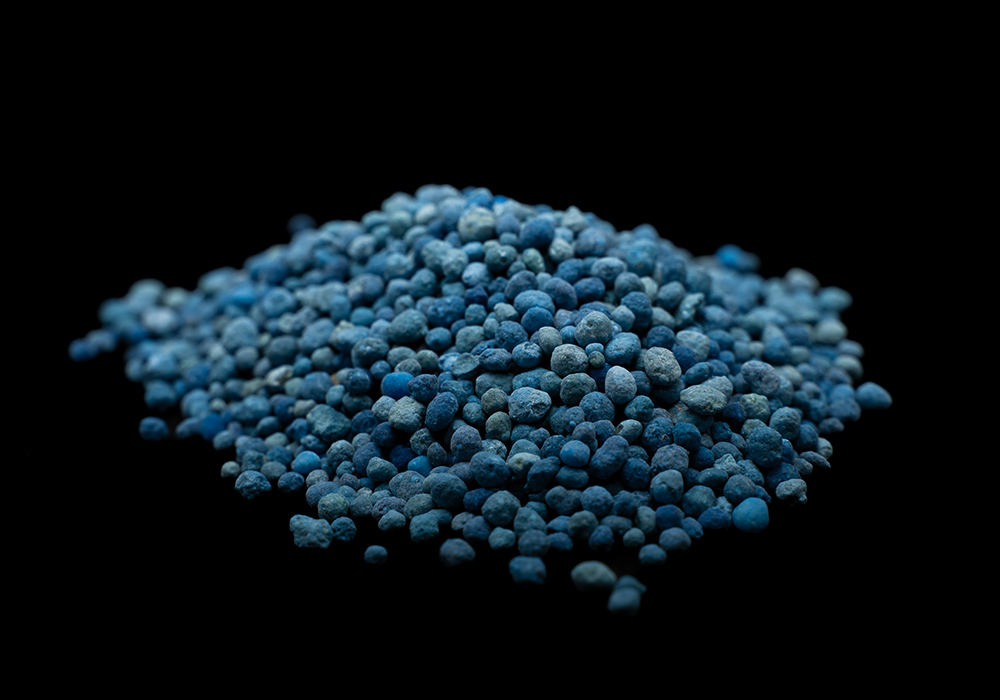

You are at the fertilizer shop. Two bags sit side by side. One says 15-15-15. The other says 16-16-16. The second one costs a bit more. Is it worth it?
Here is the short answer.
- 15-15-15 and 16-16-16 are the same ratio. One is just a little stronger. Which one to buy is a price question, and we give you a simple rule below.
- 12-12-17 is different. It has extra potassium (K) for trees that are bearing fruit. Which one to buy here depends on what your crop is doing right now.
This guide explains both, in plain language. If you want the basics on what N, P and K do for a plant, read our guide to NPK fertilizers first.
What the three numbers on the bag mean
The three numbers tell you how much of each nutrient is in the bag, as a percentage by weight.
So a 50 kg bag of 16-16-16 has 8 kg of nitrogen, 8 kg of phosphate and 8 kg of potash. The other 26 kg is not empty weight. Plants cannot take pure nitrogen, phosphorus or potassium. Each nutrient comes as a salt, and the label only counts the nutrient part of that salt. The rest of the bag is the other half of those salts (things like sulphate and chloride), a little moisture, and a thin coating that stops the granules sticking together.
One detail that is easy to miss. The first number is nitrogen (N). But the second and third numbers are not pure phosphorus and potassium. They are counted as phosphate (P2O5) and potash (K2O), which is the way fertilizer has always been labelled.
In pure element terms, a 16-16-16 bag has about 16% nitrogen, 7% phosphorus and 13% potassium. You do not need to remember this. Every NPK bag in Malaysia uses the same system, so you can compare the numbers on one bag with the numbers on another.
The three ratios at a glance
| 15-15-15 | 16-16-16 | 12-12-17+2MgO | |
|---|---|---|---|
| Nutrient in a 50 kg bag | 22.5 kg | 24 kg | 20.5 kg, plus 1 kg magnesium oxide (MgO) |
| Type | Balanced | Balanced, a bit stronger | Extra potassium |
| Best for | Young plants, leaf and root growth, mature trees between crops | The same, with fewer bags | Trees bearing fruit, mature oil palm |
| Less suited to | Trees while fruit is filling | Trees while fruit is filling | Young plants still building leaf and roots |
15-15-15 vs 16-16-16: the same ratio, different strength
Both are balanced. Both have equal parts N, P and K. Both do the same job: general feeding. They are the usual choice for young plants, for leaf, stem and root growth, and for mature trees between crops.
The only real difference is the amount of nutrient in the bag. A 50 kg bag of 15-15-15 has 22.5 kg of nutrient. A 50 kg bag of 16-16-16 has 24 kg. That is about 7% more.
So here is the rule.
If 16-16-16 costs less than 7% more than 15-15-15, buy 16-16-16. If it costs more than 7% more, buy 15-15-15.
An example. Say 15-15-15 is RM 100 a bag. Seven percent more is RM 107. If 16-16-16 is RM 105, it is the better buy. If it is RM 110, take the 15-15-15. (Prices are examples only. Use the quotes in front of you.)
This rule only works when both bags are the same kind of product. Check that both are compound fertilizers (see “What the numbers do not tell you” below) before you compare prices.
One thing to ignore. Some sellers describe one as “for fruiting” and the other as “for leaf”. There is no basis for that. They are the same ratio. Neither is made for fruiting. If your tree is bearing fruit, you need a different bag altogether (see below).
One thing that does matter on a big farm. Because 16-16-16 is stronger, you need fewer bags for the same amount of nutrient. On an estate, that saves on transport, storage and labour. On a small farm buying a few bags at a time, it makes no difference.
12-12-17+2MgO: the one with extra potassium
This is the ratio that is worth understanding, because choosing it is about your crop, not the price.
Why the extra potassium. A tree bearing fruit uses a lot of potassium. Potassium controls how the plant handles water, helps it cope with dry spells and disease, and goes into fruit size and bunch weight. In oil palm, potassium is the nutrient the palm takes out of the field in the largest amount, because it is stored in the bunches and stalks you harvest. Every tonne of bunches carries away roughly 4 kg of potassium, against about 3 kg of nitrogen. A balanced fertilizer may not give a fruiting tree enough of it.
Why the magnesium. Most Malaysian upland soils lose magnesium easily. Heavy rain washes it down below the roots, and sandy or acidic soils lose it fastest. Heavy potash rounds make it worse, because a lot of potassium in the soil makes it harder for the palm to take up magnesium. In oil palm, the sign is the older fronds turning yellow, then orange, on the side that faces the sun, while the shaded parts stay green. People call this “orange frond”. It looks similar to potassium shortage, so a leaf test is the safe way to tell them apart.
Having 2% MgO built into the compound means a little is applied with every round. It is useful, but it is only a fraction of what a kieserite round gives. It does not replace kieserite if leaf analysis shows a real shortfall. Our oil palm fertilizer program shows where each fits.
Which ratio for which crop
This is the part to save.
| Crop and stage | Use | Notes |
|---|---|---|
| Oil palm, young (planting to about Year 3) | 16-16-16 | Building fronds and roots. Add kieserite and borate separately. See our oil palm program |
| Oil palm, mature (from when you start harvesting, about Year 3 to 4) | 12-12-17+2MgO | Bunch production. Boron added separately |
| Mango, young (planting to Year 3) | 16-16-16 | Six rounds a year in our mango program |
| Mango, bearing (Year 4 onwards) | 16-16-16 and 12-12-17+2MgO | Three rounds of each a year in our program |
| Durian, after harvest | 16-16-16 | Helps the tree recover. About 2 to 3 kg for a full-sized tree |
| Durian, before flowering | Low N, high P and K (for example 8-24-24) | Too much nitrogen now gives leaves instead of flowers |
| Durian, fruit growing | 12-12-17+2MgO | About 2 to 3 kg for a full-sized tree, roughly 60 days after flowering. The Thai schedule also adds a small SOP round about a month before harvest |
The oil palm and mango rows are from our own programs. The durian rows follow published Thai orchard guidance, which Malaysian growers also use. We are working on a full durian program of our own. Programs for pineapple, paddy, banana and chilli are coming. If you grow one of these, ask us and we will send you a recommendation.
Whatever the crop, spread the fertilizer evenly under the canopy of the tree, not against the trunk.
So which one is best?
There is no single best NPK ratio. Anyone who tells you there is one best ratio is skipping the question of what your crop needs right now.
The best ratio is the one that matches what your crop is doing this month, at the lowest cost per kilogram of nutrient. In three lines:
- Young plants, leaf and root growth: balanced 15-15-15 or 16-16-16, whichever is cheaper per kg of nutrient.
- Trees bearing fruit, mature oil palm: 12-12-17+2MgO.
- Between 15-15-15 and 16-16-16: use the 7% rule.
If you already know what you need, our NPK fertilizer range shows what we supply. If you are not sure, start with the crop programs.
What the numbers do not tell you
Two bags with the same numbers can behave very differently in the field. Here are three things to check.
1. Is it a compound or a blend? In a compound fertilizer, every granule has the full mix. In a blend, different granules are mixed together in the bag. If the granules are not all the same size, they separate when the bag is moved, poured or spread. The mix at the bottom of the bag can end up different from the top, and one pass of the spreader can get more of one nutrient than the next. In Malaysia both kinds are sold as “16-16-16”. A compound has granules that all look the same. A blend shows granules of different colours and sizes. If the bag does not say “compound” or “sebatian”, ask.
2. What kind of potassium is it? Potassium comes as muriate of potash (MOP) or sulphate of potash (SOP). Both show up as the same K number on the bag. MOP is cheaper and works well for almost every crop. SOP costs more and is worth it mainly for chloride-sensitive crops like citrus. For durian, the evidence is thin. One Thai trial on one orchard found that MOP did not raise chloride in the fruit and did not change flesh colour. It did not test taste or sweetness. MOP is a reasonable choice on well-drained soil. If you want to play safe on the last round before harvest, that is where growers usually use SOP.
3. What does the granule look like? Hard, even granules spread evenly. Dusty, broken or caked fertilizer spreads unevenly. Dust blows away or sticks to the bag, and lumps land in one place, so part of what you paid for is wasted. Store bags off the ground, dry, and out of the sun.
If your fertilizer has urea in it, one more tip. Urea spread on a hot, damp surface and left there can lose a large share of its nitrogen into the air. Work it into the soil, or apply it just before a proper shower that soaks the ground. A light drizzle is not enough. It wets the urea and makes the loss worse.
A number on a bag is a promise, not a guarantee. That is why choosing a good supplier matters as much as choosing the ratio.
Working out which bag is cheaper
One line of maths:
Cost per kg of nutrient = bag price divided by kg of nutrient in the bag
| 15-15-15 | 16-16-16 | |
|---|---|---|
| Bag price (50 kg), example | RM 100 | RM 105 |
| Nutrient in the bag | 22.5 kg | 24 kg |
| Cost per kg of nutrient | RM 4.44 | RM 4.38 |
In this example, 16-16-16 is cheaper per kg of nutrient even though the bag costs more. Do the same sum with your own quotes. It takes ten seconds.
This sum only works for bags with the same ratio, like 15-15-15 against 16-16-16. Do not use it to compare a balanced bag with 12-12-17. Those carry a different mix of nutrients, so the choice between them is about your crop, not the price per kg.
Three mistakes that cost money
Most of the money wasted on NPK comes from three habits. All three are easy to fix.
Paying more for 16-16-16 because it sounds better. It is not better. It is the same ratio with about 7% more nutrient in the bag. If the price gap is bigger than 7%, the cheaper bag of 15-15-15 is the better buy. The same goes for 19-19-19 against 20-20-20, with one warning: 20-20-20 is usually a soluble powder for spraying or drip, not a granule for the ground, so only compare like with like.
Staying on a balanced bag while the fruit is filling. Balanced NPK is the right choice for young plants and for mature trees between crops, including durian after harvest. But it usually gives too little potassium once the fruit is growing. That is the moment to switch to, or add, a high-potassium bag like 12-12-17.
Paying extra for SOP when you do not need it. For most crops, MOP does the job. For durian, the evidence either way is thin: one Thai trial found MOP did not push chloride into the fruit, yet many growers still use SOP for the last round before harvest. If your soil drains well, MOP is a reasonable choice. If it drains poorly or your water is salty, use SOP for that last round.
Getting it right for your crop
The numbers on the bag are a starting point. What decides your yield is matching the ratio to the growth stage, checking what is really in the bag, and paying for nutrient, not packaging.
If you know what you need, our NPK fertilizer range is here. If you would rather talk it through, tell us what you grow and we will put a program together for you.
