
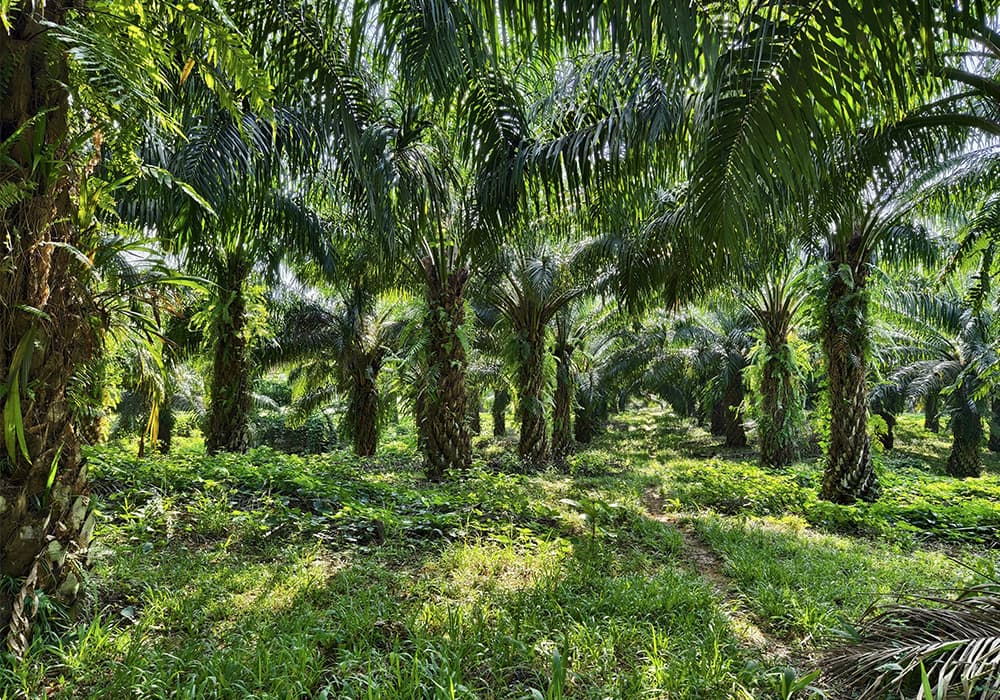

Engineered for Malaysian Tenera (cv. Tenera) from field transplant through Year 15, this program is designed around the two outputs that decide an estate’s economics: fresh fruit bunch (FFB) weight and oil extraction rate (OER). Every product, dose, and timing in the schedule below is selected to support those outcomes.
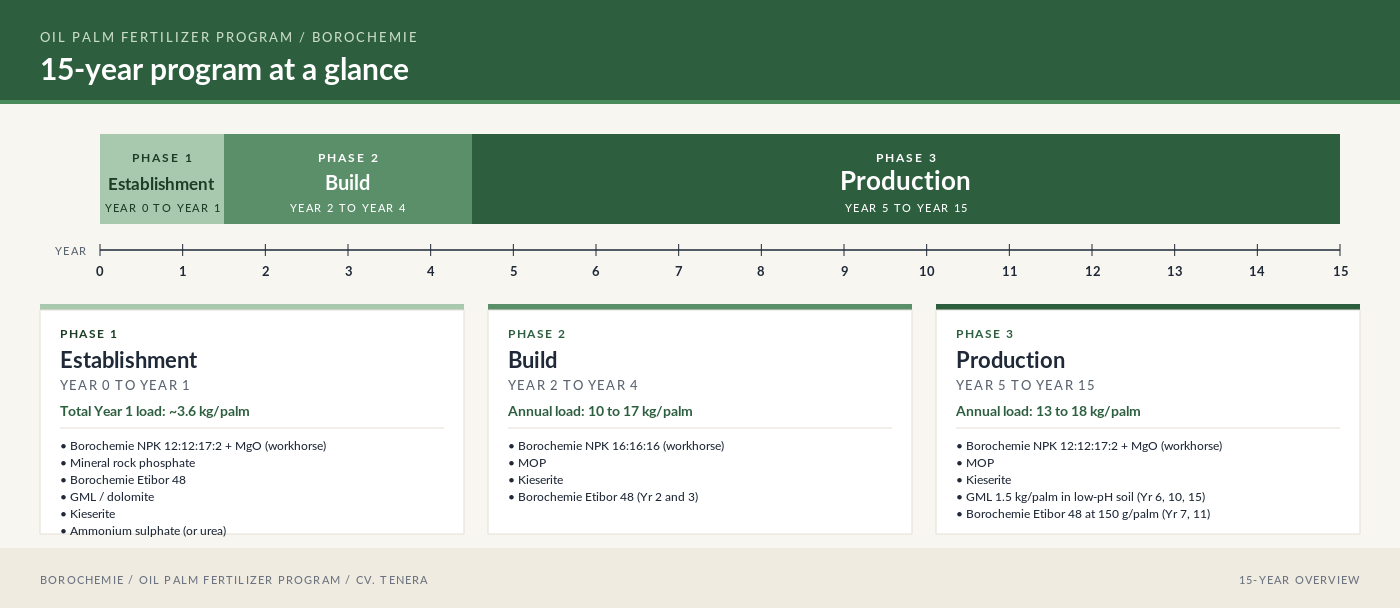
The program runs in three phases. Phase 1 covers the first 12 months of field transplant, building rooting and frond architecture. Phase 2 (Years 2 to 4) drives vegetative dry matter and primes early bunch development. Phase 3 (Years 5 to 15) sustains production at the higher-K nutrient profile a producing palm requires.
Phase 1: Establishment (Year 0 to Year 1)
The first-year program for newly transplanted palms.
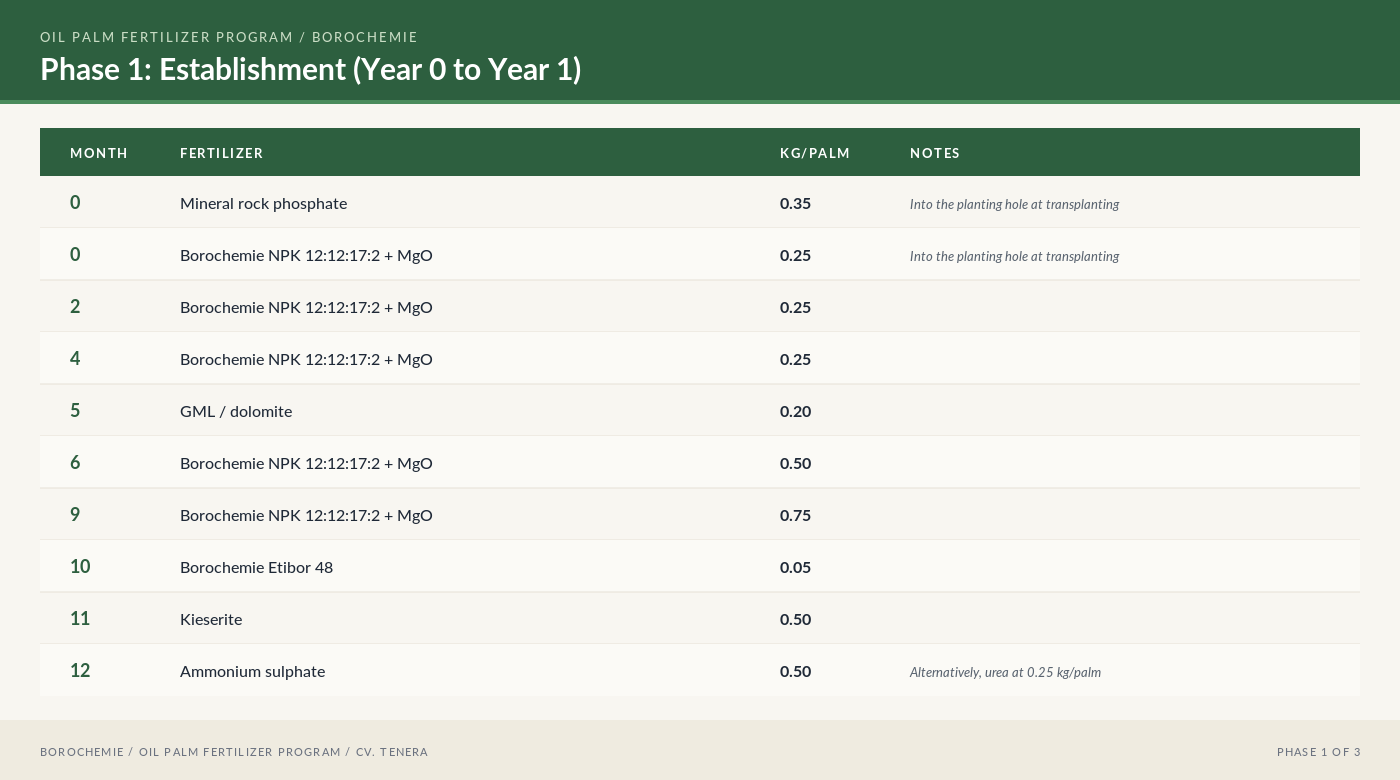
The objective in Phase 1 is rooting and frond architecture, not bunch yield. Borochemie NPK 12:12:17:2 + MgO is dosed in stepped applications through the year, climbing as the canopy thickens. GML or dolomite at month 5 corrects pH ahead of peak nutrient demand, so the nitrogen and potassium applied later actually reach the palm. Borochemie Etibor 48 enters at month 10 to safeguard emerging bunch primordia. The year closes with kieserite for magnesium and ammonium sulphate (or urea) for a nitrogen finish.
Phase 2: Build (Year 2 to Year 4)
The vegetative build phase.
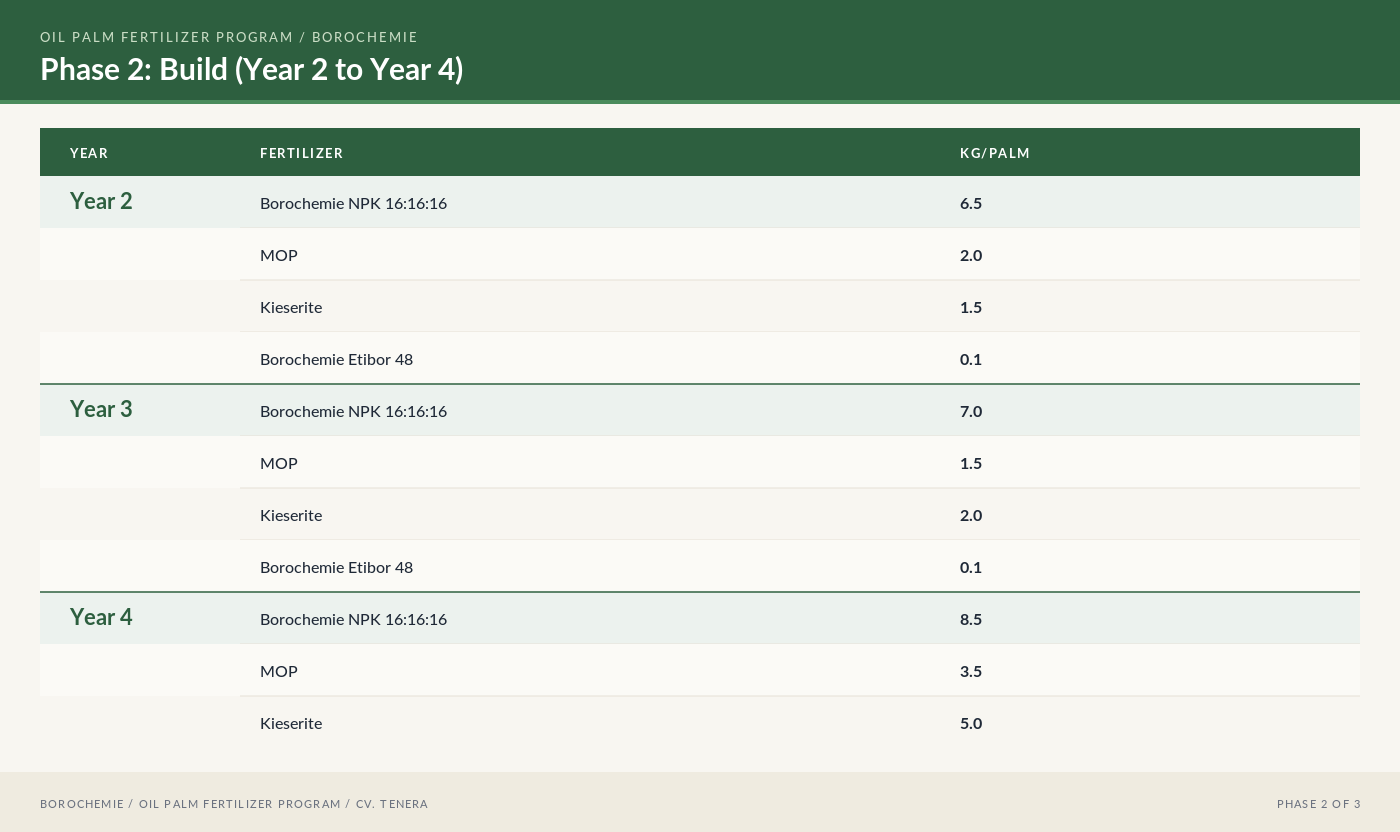
Borochemie NPK 16:16:16 carries this phase as a balanced compound that matches the equal demand for N, P, and K in young palms putting on canopy. MOP supplies additional potassium; kieserite supplies magnesium. Borochemie Etibor 48 stays in the schedule through Year 3 to safeguard the bunches that will be cut in Years 5 and 6. Mistakes made in this window, particularly under-application of K, show up as small, light bunches three years later, and they cannot be corrected retrospectively.
Phase 3: Production (Year 5 to Year 15)
The producing-palm program.
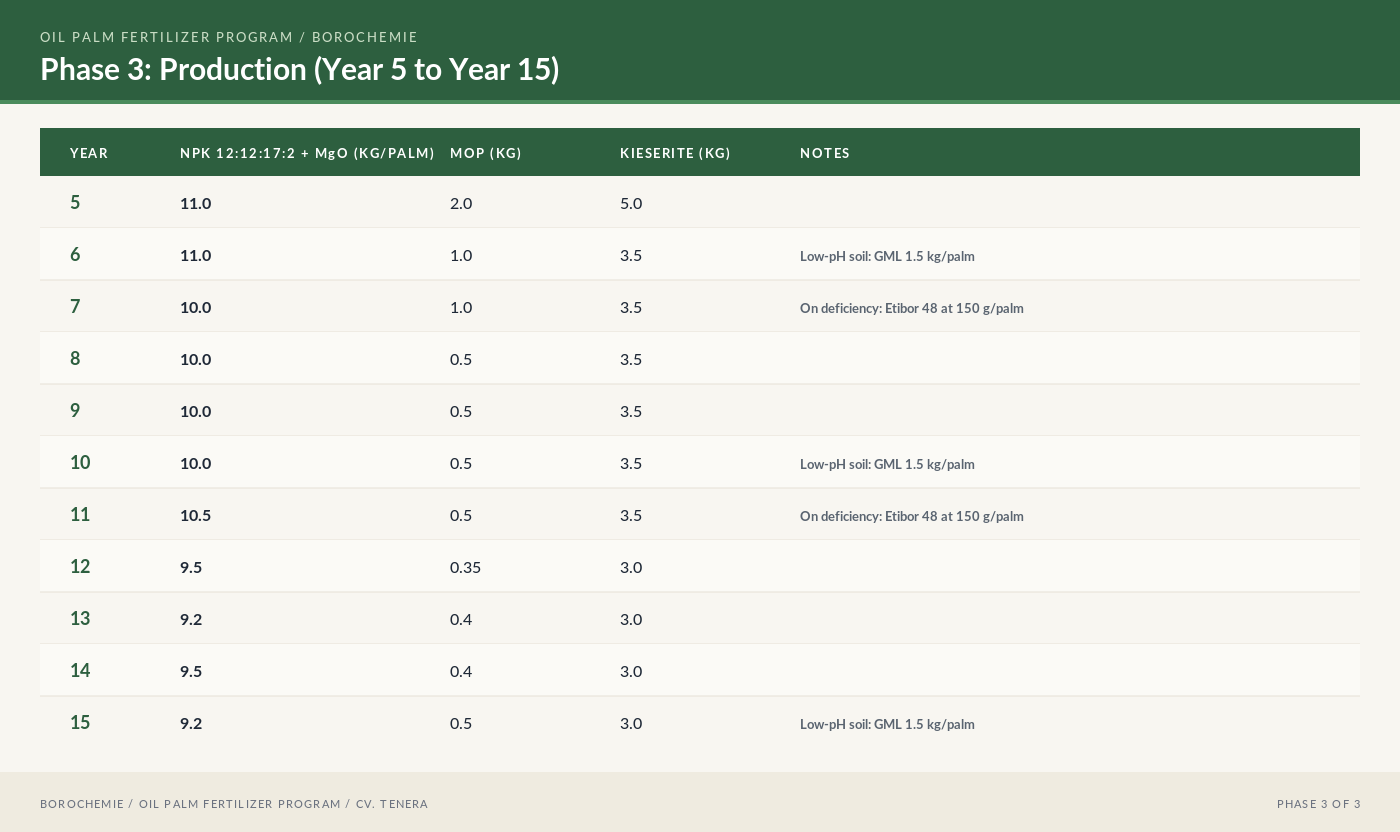
From Year 5 the program transitions to Borochemie NPK 12:12:17:2 + MgO, the higher-K, lower-N profile that matches a producing palm’s economics. The 17% K and 2% MgO match what a producing Tenera palm actually pulls from the soil per tonne of FFB. Annual NPK doses settle at 9.2 to 11 kg/palm, with kieserite at 3 to 5 kg/palm and MOP tapering as the palm reaches steady-state nutrient turnover. GML at 1.5 kg/palm is scheduled for low-pH soils in Years 6, 10, and 15. Borochemie Etibor 48 at 150 g/palm is on standby in Years 7 and 11; apply on observed deficiency.
Why a compound NPK
Some estates still mix straights at the bunker. The Borochemie compounds (NPK 12:12:17:2 + MgO, NPK 16:16:16, and Etibor 48) are engineered to remove that variability. Each granule carries every declared element in the declared ratio, so no palm receives a bag-end of pure urea while its neighbour gets a bag-end of pure MOP. For estates running long rounds across uneven terrain, this granule-level uniformity is the single most under-appreciated lever on FFB consistency.
NPK 12:12:17:2 + MgO is the workhorse for both establishment (small monthly doses in Phase 1) and mature production (10 to 11 kg/palm/year in Phase 3).
NPK 16:16:16 carries the build phase, where nitrogen demand is still high relative to potassium.
Etibor 48 delivers boron at 48%, the cheapest insurance line on the entire program.
Boron is not optional
Boron deficiency in Malaysian Tenera estates is the deficiency that costs most and is diagnosed least. The visible symptoms (hooked or fish-tail leaflets, deformed bunches, fruit-set failure) appear after the yield damage is already booked. Foliar sampling of Frond 17 catches the deficiency before that damage is booked, which is why leaf nutrient benchmarks, not visual inspection alone, should guide boron decisions.
The program builds boron in twice during establishment (month 10, then again in Years 2 and 3 via Etibor 48) and keeps a corrective 150 g/palm dose on standby in Years 7 and 11. At under 200 g per palm per intervention, Etibor 48 is the lowest-cost, highest-leverage line item on the schedule.
Next step
If you would like the program adapted to your estate’s soil analysis, foliar sampling history, or specific deficiency profile, the Borochemie agronomy team will overlay the schedule on your block-level data and return a customised manuring program within a few working days.
Send your most recent foliar and soil reports to your Borochemie account manager, or request an estate visit.
