
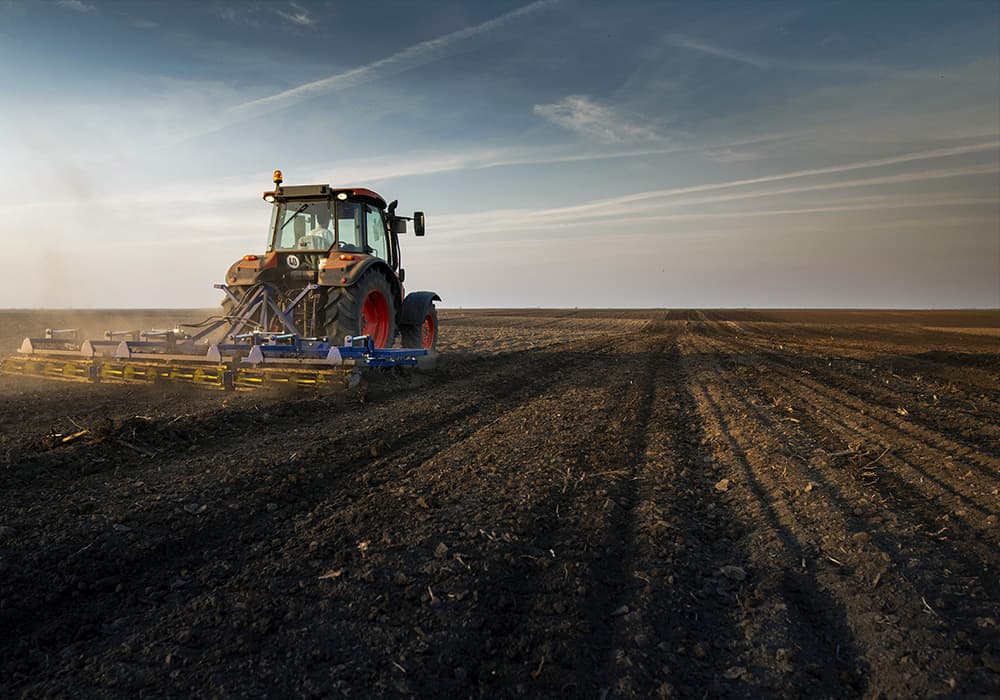

Picture this: you have just finished a full round of fertilizer application across your fields. The labour cost was significant, the product was not cheap, and three days later, the rain comes down hard. By the time the soil dries out, most of those nutrients have already leached past the root zone and into the groundwater. Your plants got a fraction of what you paid for, and your next application is already due.
This is not an unusual scenario. It happens on farms and plantations across the region every season. And in most cases, it comes down to one overlooked decision: how fast should those nutrients actually reach your plants?
The speed of nutrient release can be the difference between a thriving crop and a wasted application. Whether you manage a large plantation, run a commercial nursery, or oversee field operations, understanding the distinction between fast release and slow release fertilizers is fundamental to getting the most out of every bag you apply.
Let us break it down.

What Is Fast Release Fertilizer?
Fast release fertilizers, also called quick release or water soluble fertilizers, do exactly what the name suggests. Once applied, they dissolve rapidly in water and deliver nutrients to the soil almost immediately. Plants can begin absorbing those nutrients within days, sometimes even hours, of application.
They typically come in liquid form or as water soluble granules, and they are widely available and generally less expensive upfront than their slow release counterparts.
The key benefits of fast release fertilizers
- Rapid correction of visible nutrient deficiencies
- Quick greening response in lawns and foliage crops
- Flexibility, making it easy to adjust dosage between applications
- Lower cost per unit of nutrient
- Well suited for short cycle crops and container plants that need immediate feeding
However, because nutrients dissolve so quickly, they are equally quick to leach out of the soil, especially in high rainfall environments or on sloped terrain. This means more frequent reapplications, greater labour input, and a real risk of fertilizer burn if dosage is not carefully managed.
The Risk of Fertilizer Burn
Fertilizer burn is one of the more costly and avoidable consequences of fast release products when overapplied. When soluble nutrients are present in excessively high concentrations around the root zone, the osmotic pressure gradient reverses. Instead of the plant drawing moisture and nutrients inward, moisture is actually pulled out of the root cells and into the surrounding soil solution. The result is wilting, scorched leaf tips, root damage, and in severe cases, crop loss.
This is not a rare edge case. It is a genuine operational risk, particularly for businesses applying fast release fertilizers at scale or under pressure to speed up crop cycles. Maintaining strict application rates and avoiding application during the hottest parts of the day are the primary ways to manage this risk.
What Is Slow Release Fertilizer?
Slow release fertilizers are engineered to break down gradually, feeding the soil over a period of weeks or even months rather than days. Instead of flooding the root zone with nutrients all at once, they deliver a steady, measured supply, working more like a drip system than a flood.
The key benefits of slow release fertilizers
- Sustained nutrient availability over an extended growing period
- Significantly reduced leaching losses
- Lower risk of fertilizer burn due to controlled nutrient concentration
- Fewer applications required, reducing labour costs over time
- Improved Nutrient Use Efficiency (NUE), making each kilogram of fertilizer work harder
- Better environmental profile with less nutrient runoff into waterways
For businesses managing field planted crops across large areas, these advantages translate directly into operational savings and more consistent crop performance.
How Do the Two Compare?
The most practical way to think about the difference is this: fast release fertilizers give you control and speed, while slow release fertilizers give you efficiency and longevity.
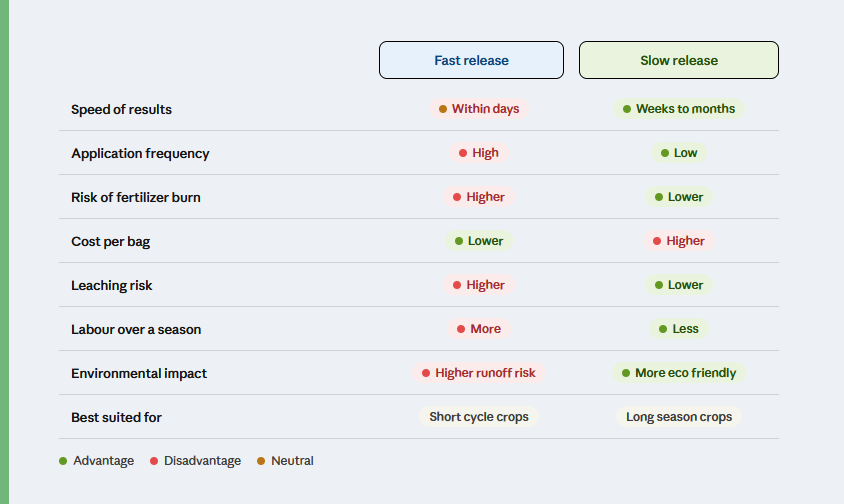
Fast release is the better choice when you need to act quickly, correcting a deficiency mid season, boosting a crop that is falling behind, or feeding short cycle crops like leafy vegetables that will be harvested before a slow release product would even finish working.
Slow release, on the other hand, is better suited for long term investment in soil productivity. The nutrients stay in the root zone longer, which means more of what you pay for actually ends up in the plant rather than washing away with the next rainfall. However, because the release mechanism depends on water and time, it can be slower to respond during dry spells, something to factor into your planning.
When Should You Use Each One?
Rather than treating this as a binary choice, think of it as a decision framework based on your specific growing conditions.
In general, farmers utilizing field planting will benefit most from slow release fertilizers. The slow rate of nutrient release reduces leaching, especially in tropical climates with high rainfall, and on terrace planting in undulating to hilly areas. Slow release ensures that nutrients persist longer in the soil where the roots can access them consistently throughout the growing cycle.
Using Both Types of Fertilizer Together
One of the most effective strategies used by experienced agronomists and commercial growers is not choosing one or the other, but combining both types within a single fertilizer programme.
The approach works like this: a slow release fertilizer is applied as the base dressing at or before planting. This establishes a steady reservoir of nutrients in the soil that feeds the crop gradually over the coming weeks and months. Then, at key growth stages when nutrient demand peaks, such as during flowering, fruit set, or rapid vegetative growth, a targeted fast release application is made to deliver an immediate boost precisely when the plant needs it most.
This combination approach gives you the best of both worlds. The slow release base reduces labour and leaching losses across the majority of the season, while the fast release top ups give you the flexibility to respond to crop signals in real time. For high value crops or large scale operations where both efficiency and yield quality matter, this dual strategy is worth serious consideration.
How Does Borochemie NPK Fertilizer Control Nutrient Release?
A common question among growers is: if Borochemie does not rely solely on coated granules, how does it manage controlled release?
The answer starts with understanding that “slow release” as an industry term has only recently been formally standardised. The International Standards Organisation (ISO) only established a benchmark for it in 2017. Prior to that, the term was used loosely across the industry without regulation or consistent definition.
In practice, there are several ways to reduce the rate of nutrient release in granular fertilizers beyond external coatings. Chemically, manufacturers can select raw materials with inherently lower solubility. For example, using rock phosphate rather than DAP as a phosphorus source results in slower nutrient availability. Mechanically, granule size and granulation method, wet versus dry, also influence how quickly a product dissolves and releases its nutrients into the soil.
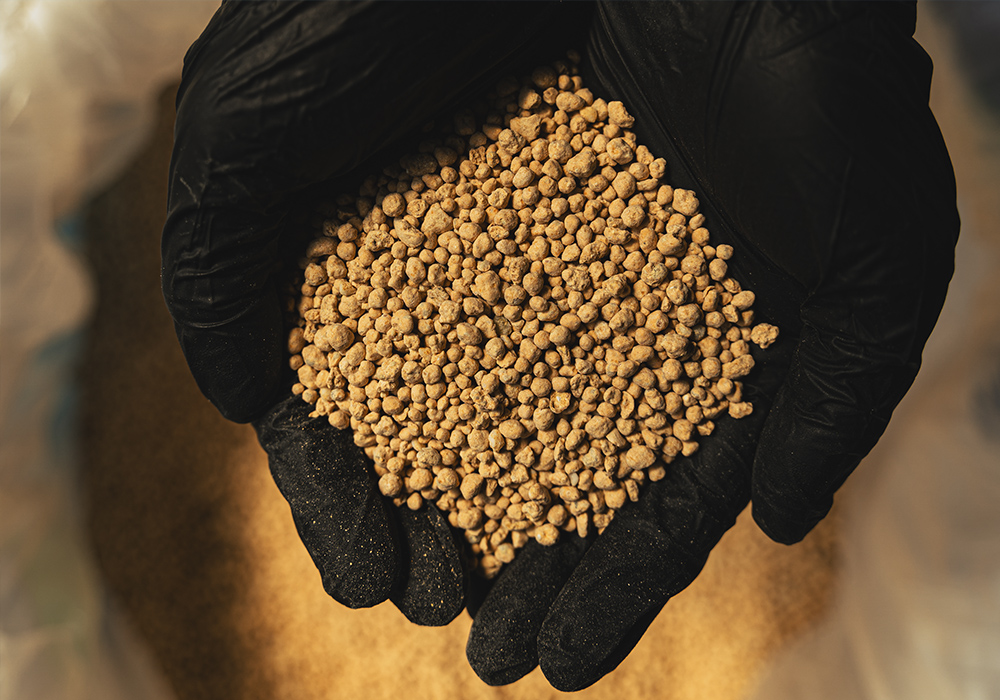
For Borochemie NPK compounds, we utilise a sulphur coating as part of the slow release mechanism. This sulphur shell contains tiny pores through which moisture interacts with the granule. The coating is partially water permeable, meaning water gradually infiltrates the shell and triggers dissolution of the nutrient core at a controlled rate. In wetter soil conditions, more moisture enters the granule and nutrient release accelerates. In drier conditions, the process naturally slows. This dynamic interaction between the coating and soil moisture is what governs the release timeline.
Field observations from Borochemie’s pineapple trial support this directly. NPK 16-16-16 granules were found to persist in the soil one month after application under plastic mulch, a clear indicator of genuine controlled release behaviour rather than rapid dissolution.
Leaching and Environmental Impact
The environmental case for slow release fertilizers is compelling. When nutrients leach out of the soil and into groundwater or surface waterways, the damage goes beyond wasted money. It contributes to water pollution and ecosystem disruption.
Slow release fertilizers address this directly. By keeping nutrients in the root zone longer, they reduce the volume of nutrients that escape through leaching, which improves NUE and means a higher proportion of the fertilizer you purchase is actually taken up by the crop. For businesses managing fertilizer costs at scale, that efficiency has a measurable impact on the bottom line.
It is worth noting, however, that over-application can eliminate these advantages entirely. If dosage is not properly calculated, even a slow release product can result in excess nutrients in the soil, negating both the environmental and economic benefits. Proper soil testing and dosage planning remain essential regardless of which fertilizer type you choose.
Slow Release Saves Cost in the Long Run
The economics of slow release fertilizers deserve careful examination. The upfront cost per bag is typically higher than fast release alternatives, and that is a legitimate consideration for any operation managing tight input budgets.
The full picture looks different, however, when you account for total cost over a growing season. Fewer applications mean less labour. Higher NUE means less product wasted to leaching. More consistent nutrient availability means less risk of crop underperformance between applications. For long season, field planted crops, the savings in labour and product efficiency can more than offset the premium upfront cost.
Slow release is not a universal solution, however. For short cycle crops, the economics may not stack up, as the crop may be harvested before the slow release product has fully delivered its nutrients. In those cases, fast release products remain the more practical and cost effective choice.
The best approach is to evaluate the cost benefit ratio based on your specific planting variables: crop type, season length, rainfall, terrain, and current labour costs. For most field operations in tropical regions with extended growing seasons, slow release fertilizers represent a sound long term investment.
Conclusion
Choosing between fast release and slow release fertilizer is not just a technical decision. It is a business decision. The speed at which nutrients reach your plants affects crop performance, input efficiency, labour requirements, and environmental compliance all at once.
Fast release products give you speed and flexibility. Slow release products give you endurance and efficiency. A combined approach gives you both. Understanding when each is appropriate, and why products like Borochemie NPK are formulated the way they are, puts you in a stronger position to manage your inputs strategically and get the most from every application.
When in doubt, start with your soil and your crop calendar. The right fertilizer strategy begins there.
If you are considering Borochemie NPK Fertilizers for your operation, you do not have to figure it out alone. We provide hands on guidance and technical assistance to help growers apply our products effectively, from choosing the right formulation for your crop type to optimising dosage and application timing for long term results.
